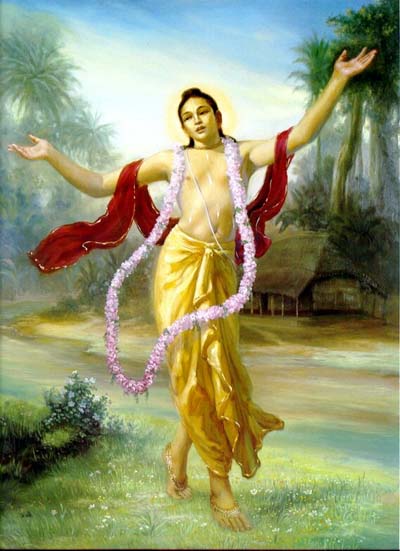
Caitanya Mahaprabhu

Hare Krishna dear devotees,

Today is the most auspicious Gaura Purnima, appearance day of Sri Caitanya Mahaprabu.

Krishna says in Bhagavad Gita 4.9

janma karma ca me divyam evaṁ yo vetti tattvataḥ
tyaktvā dehaṁ punar janma naiti mām eti so ’rjuna

One who knows the transcendental nature of My appearance and activities does not, upon leaving the body, take his birth again in this material world, but attains My eternal abode, O Arjuna.

So Krishna is saying that if we know Krishna, or His actions, in tattva then we will not take birth again. The dictionary meaning of tattva is ‘principle’, ‘reality’ or ‘truth’.  It sounds too simple but it is a very deep topic. Those who do get to understand Krishna in tattva their life completely changes, their consciousness and the very purpose of being will change. As this has not happened to many of us, specially true for my own poor self, that would imply that we do not know Krishna in tattva. That is why Srimad Bhagavatam first introduces all the incarnations so that step by step we will reach towards Krishna and then understand His position, His pastimes in tattva. Now if this is true for Krishna then we can understand how difficult it is to understand the position of Mahaprabhu. He is described as a ‘channa avatara’, hidden incarnation, in the scriptures. But if we do become fortunate to understand Mahaprabhu in tattva then as per the above Bhagavad Gita verse we will not take a birth again because there is no difference between Krishna and Mahaprabhu.

So in this auspicious day I am sharing some part of ‘Gaura Tattva’ from a book called Gaudiya Kanthahar which is a compilation of choicest verses from various Upanishad, puranas, Mahabharat, etc. on topics like Guru tattva, Krishna tattva, jiva tattva , maya tattva, etc,  by Sri Atinddriya Das Adhikari a disciple of Srila Bhaktisidhanta Saraswati Thakura. His compilation was mainly from the writings of his guru maharaj  Srila Bhaktisidhanta Saraswati Thakura, who, when presented with this book, was extremely pleased with this compilation. I hope this will nurture our devotional life and help us understand Sri Caitanya Mahaprabhu in tattva.

Gaura-tattva

The Evidence From Sruti for Lord Caitanya

mahan-prabhur vai purusah sattvasyesa pravarttakah

surnimalam imam santimisano jyotiravyah

The Personality of Godhead, Shri Caitanya Mahaprabhu, is brilliantly effulgent and imperishable like molten gold. He is the Supreme Controller. He controls the mode of goodness and through saokirtana bestows spiritual intelligence on the living beings. In the guise of a sannyasi, He is the source of spiritual purity and of liberation. He is therefore known as “Mahaprabhu”. (Svetasvatara Upanisad 3.12)

yada pasyah pasyate rukma-varnam kartaram isam purusam brahma-yonim

tada vidyan punya-pape vidhuya niranjanah paramam samyam upaiti

When one realizes the golden form of Lord Gauranga, who is the ultimate actor and the source of the Supreme Brahman, he attains the highest knowledge. He transcends both pious and impious activities, becomes free from worldly bondage, and enters the divine abode of the Lord. (Mundaka Upanisad 3.3)

Evidence From Bhagavatam for Lord Caitanya

 krishna-varnam tvisakrishnam sangopangastra-parsadam

yajnaih saokirtana-prayair yajanti hi su-medhasah

In the age of Kali, Krishna appears in a golden form, chanting the two syllables krs-na. He descends along with His weapons, limbs, saktis, and eternal confidential associates. Those with intelligence worship Him with the saokirtana yajna. (Bhag. 11.5.32)

‘krishna’ ei dui varna sada yaora mukhe athava, krishnake tioho varne nija sukhe.

krishna-varna-sabdera artha dui ta pramana krishna vinu taora mukhe nahi aise ana.

deha-kantye haya teoho akrishna-varana akrishna-varane kahe pita-varana.

The two syllables krs-na are always in His mouth, or He always describes Krishna with great pleasure. These are two meanings of the words “krishna varna.” Indeed, nothing but Krishna issues from His mouth. If someone tries to describe Him as blackish, the next adjective, tvisakrishnam, immediately restricts him. His complexion is certainly not blackish. Indeed, His not being blackish indicates a golden complexion. (Cc. Adi 3.54,55,57)

asan varnas trayo hy asya grhnato ‘nuyugam tanuh

suklo raktas tatha pita idanim krishnatam gatah

This boy, Krishna, has three other colors: white; red, and yellow, as He appears in different ages. Now, in this Dvapara-yuga, he has appeared in a transcendental blackish color. (Bhag. 10.8.13)


ittham nr-tiryag-rsi-deva-jhasavatarair lokan vibhavayasi hamsi jagat-pratipan

dharmam maha-purusa pasi yuganuvrttam channah kalau yad abhavas tri-yugo ‘tha sa tvam

 [Prahlada said] O Krishna, in this way You appear in various incarnations: as a human being, an animal, a great saint, a demigod, a fish, or a tortoise, thus maintaining the entire creation in different planetary systems. In this way, according to the age, You protect the principles of religion, but, O Mahaprabhu, in the age of Kali, You do not assert Yourself as the Supreme Personality of Godhead. Because Your incarnation is hidden in the age of Kali You are known as Triyuga, or the Lord who manifests His supremacy in only three ages. (Bhag. 7.9.38)

Evidence From Mahabharata for Shri Caitanya

suvarna-varno hemango varangas-candanangadi

sannyasa-krcchamah santo nistha-santi-parayanah

When Krishna appears as Lord Gauranga, in His early pastimes His complexion is golden (suvarna-varna), His limbs are the color of molten white gold (hemanga), His body is extremely beautiful (varangas), and He is decorated with sandalwood pulp (candanangadi). Shri Caitanya accepts sannyasa (sannyasa-krt), and shows equanimity (sama). He is peaceful (santa). His mind is always fixed on Krishna, and thus He is nistha, or fixed, in performing the great sacrifice of the holy name of Krishna. He silences the non-devotees and impersonalists who are opposed to the service of the Lord, by promoting the cause of devotion. Thus He distributes real peace. He is therefore an abode of the highest spiritual peace and devotion. (Mahabharata, Dan-dharma ch.149)


The Version of the Gosvamis

antah krishnam bahir-gauram darsitangadi-vaibhavam

kalau saokirtanadyaih smah krishna-Caitanyam-ashritah

I take shelter of Shri Krishna Caitanya Mahaprabhu, who is Krishna Himself, thinking of Himself. He is internally Krishna blackish but externally, he appears in golden complexion. In this age of Kali, Krishna appears as Krishna Caitanya, simultaneously manifesting His eternal associates, opulences, expansions, and incarnations. In this way, he preaches the process of Krishna consciousness by performing saokirtana. (Tattva-sandarbha 2)


Sri Gauranga is the Source of all Avataras

sutiya acchinu ksira-sagara-bhitare

mora nidra bhanga haila nadara huokare

[While sitting on the altar of Vishnu in the house of Shrivasa, Lord Caitanya said] Lying within the ocean of milk, My transcendental slumber broke, as I awoke to hear the loud cries of My devotees, thus I [Lord Vishnu] have come [as Lord Caitanya]. (Cb. Madhya 22.16)


Lord Caitanya’s sixfold Nature

sakala vaishnava, suna kari’ eka-mana Caitanya-krsnera sastra-mata-nirupana.

krishna, guru, bhakta, sakti avatara, prakasa krishna ei chaya-rupe karena vilasa

I advise all my Vaishnava readers to read and hear with rapt attention this narration of the pastimes of Lord Krishna Caitanya as inculcated in the revealed scriptures. Lord Krishna enjoys His pastimes by manifesting Himself as the spiritual masters (guru), His devotees (bhakta), His diverse energies (sakti), His incarnations (avataras) and His full expansions (prakasa). (Cc. Adi 1.31,32)


Lord Caitanya is the Jagad-guru

caudda bhuvanera guru Caitanya-gosani

taora guru anya, ei kona sastre nai

Sri Caitanya Mahaprabhu is the jagad-guru, the spiritual master of the fourteen worlds. No other guru can compare with Him. (Cc. Adi 12.16)


Lord Gauranga is the Best of all

saundarye kama-kotih sakala-jana samahladane candrakotir

vatsalye matrkotis tridasavitapinam kotir audarya-sare

gambhirye ‘mbodhi-kotir madhurimani sudha-ksira-maddhavihvika-kotir

gaurodevah sa jiyat pranaya-rasapade darsitascarya-kotih

Caitanya Mahaprabhu is lovelier than millions of cupids. He is mellower than millions of moons, dearer than millions of mothers, kinder than millions of wish-fulfilling trees, deeper than millions of oceans, and sweeter than millions of nectarean drinks. All glories to Shri Caitanya Mahaprabhu, the Supreme Lord, who displays millions of amazing sentiments of madhurya-bhakti, the most exalted mellow of pure love of Godhead. (Caitanya Candramrta 101)


Gauranga’s Tattva, Nama, Rupa, and Lila

namo maha-vadanyaya krishna-prema-pradaya te

krishnaya krishna-Caitanya-namne gaura-tvise namah

His nature (tattva) is that He is Krishna Himself. His name (nama) is Krishna Caitanya. His form (rupa) is golden. His quality (guna) is that He is the most magnanimous of all incarnations. His pastime (lila) is to distribute the highest love of Godhead krishna-prema. I offer my obeisances unto that most generous Lord, Shri Krishna Caitanya Mahaprabhu. (Cc. Madhya 19.53)


Gauranga Delivers All by Distributing Nama

saokirtana-pravartaka shri-krishna-Caitanya saokirtana-yajne taore bhaje, sei dhanya.

sei ta’ sumedha, ara kubuddhi samsara sarva-yajna haite krishna-nama-yajna sara

Caitanya Mahaprabhu inaugurated the saokirtana movement. One who worships Him through saokirtana is fortunate indeed. Such a person is truly intelligent, whereas others, who have but a poor fund of knowledge, must endure the cycle of repeated birth and death. Of all sacrificial performances, the chanting of the Lord’s holy name is the most sublime. (Cc. Adi 3.77,78)

Gauranga is the Giver of Krishna-prema

uchalila prema-vanya caudike vedaya stri, vrddha, balaka, yuva, sabare duvaya.

saj-jana, dur-jana, pangu, jada, andha-gana prema-vanyaya dubaila jagatera jana

The flood of love of Godhead distributed by Shri Caitanya Mahaprabhu swelled in all directions. Young men, old men, women, and children were all immersed in that inundation. The Krishna consciousness movement begun by Shri Caitanya Mahaprabhu will inundate the entire world and drown everyone, whether one be a gentleman, rogue, lame, invalid, or blind. (Cc. Adi 7.25,26)

patrapatra-vicara nahi, nahi sthanasthana yei yanha paya, taoha kare prema-dana

lutiya, khaiya, diya, bhandara ujade ascarya bhandara, prema sata-guna bade

In distributing love of Godhead, Lord Caitanya Mahaprabhu and His associates did not consider who was fit and who was unfit, nor where such distribution should or should not take place. They made no such conditions. Rather, wherever they got the opportunity, the members of the Panca-tattva distributed love of Godhead. Although they plundered the storehouse of love of Godhead, ate and distributed its contents, there was no scarcity, for this wonderful storehouse is so complete that as the love is distributed, the supply increases hundreds of times. (Cc. Adi 7.23,24)


One can Know the Conclusion of Scripture by Shri Gauranga’s Mercy

shri-Caitanya-prabhum vande balo ‘pi yad-anugrahat

taren nana-mata-graha-vyaptam siddhanta-sagaram

I offer my obeisances unto Shri Caitanya Mahaprabhu, by whose mercy even an ignorant child can swim across the ocean of conclusive truth, which is filled with the crocodiles of various theories. (Cc. Adi 2.1)


Lord Gauranga’s Preaching Pastimes

sannyasi pandita-ganera karite garva nasa

nica-sudra-dvara karena dharmera prakasa.

‘bhakti’, ‘ prema’, ‘tattva’ kahe raye kari’ ‘vakta’

apani pradyumna-misra-saha haya ‘srota’.

haridasa-dvara nama-mahatmya-prakasa

sanatana-dvara bhakti-siddhanta-vilasa.

shri-rupa-dvara vrajera prema-rasa-lila

ke bujhite pare gambhira caitanyera khela?

To vanquish the false pride of so-called sannyasis and learned scholars, He spread real religious principles, even through a sudra. Lord Caitanya preached about devotional service, ecstatic love, and the Absolute Truth by making Ramananda Raya, a grhastha from a low family, the speaker. Then the Lord, an exalted brahmana sannyasi, and Pradyumna Misra, the purified brahmana, both heard from Ramananda Raya. The Lord exhibited the glories of the holy name of Krishna through Haridasa Thakura, who was born in a Muslim family. Similarly, He exhibited the essence of devotional service through Sanatana Gosvami, who was almost converted to Islam. The Lord also fully exhibited the ecstatic love and transcendental pastimes of Vrndavana through Shrila Rupa Gosvami. Considering all this, who can understand the deep plans of Caitanya Mahaprabhu? (Cc. Antya 5.84-87)

vraje ye vihare purve krishna-balarama koti-surya-candra jini doohara nija-dhama.

sei dui jagatere ha-iya sadaya gaudadese purva-saile karila udaya.

shri-krishna-Caitanya ara prabhu nityananda yaohara prakase sarva jagat ananda.

surya-candra hare yaiche saba andhakara vastu prakasiya kare dharmera pracara.

ei mata dui bhai jivera ajnana-tamo-nasa kari’ kaila tattva-vastu-dana.

yaohara prasade ei tamo haya nasa tamo nasa kari’ kare tattvera prakasa.

surya candra bahirera tamau se vinase bahir-vastu ghata-pata-adi se prakase.

dui bhai hrdayera ksali’ andhakara dui bhagavata-sange karana saksatkara.

Krishna and Balarama, who formerly appeared in Vrndavana and who were millions of times more effulgent than the sun and moon, have arisen over the eastern horizon of Gauda-desa, being compassionate on the fallen state of the world. The appearance of Srri Caitanya and Nityananda has surcharged the world with happiness. As the sun and moon drive away darkness and reveal the nature of everything, these two brothers dissipate the darkness of the living beings ignorance and enlighten them with knowledge of the Absolute Truth. By the grace of Sri Caitanya and Nityananda, all darkness is removed and the truth is brought to light. The sun and moon dissipate the darkness of the external world and thus reveal material reality, but these two brothers dissipate the darkness of the inner core of the heart, and thus help one to meet the two kinds of Bhagavatas. (Cc. Adi 1.85-89,95,97,98)

Shri Gauranga is Like a Lion

Caitanya-simhera nava-dvipe avatara simha-griva, simha-virya, simhera huokara

sei simha vasuk jivera hrdaya-kandare kalmasa-dvirada nase yaohara huokare

Thus the lion-like Caitanya Mahaprabhu has appeared in Navadvipa-dhama. He has the shoulders of a lion, the powers of a lion, and the loud voice of a lion. May that lion be seated in the core of the heart of every living being and with His resounding roar, may He drive away their elephantine vices. (Cc. Adi 3.30,31)

Shri Gauranga’s Eternal Reason for Appearing

anarpita-carim cirat karunayavatirnah kalau

samarpayitum unnatojjvala-rasam sva-bhakti-shriyam

harih purata-sundara-dyuti-kadamba-sandipitah

sada hrdaya-kandare sphuratu vah saci-nandana

May that Lord who is known as the son of Shrimati Sacidevi be transcendentally situated in the inner-most chambers of your heart. Resplendent with the radiance of molten gold He has appeared in the age of Kali by His causeless mercy to bestow what no incarnation ever offered before the most sublime and radiant spiritual knowledge of the mellow taste of His service. (Cc. Adi 1.4)

Lord Gauranga’s Confidential Reason for Appearing

shri-radhayah pranaya-mahima kidrso vanayaiva-

svadyo yenadbhuta-madhurima kidrso va madiyah

saukhyam casya mad-anubhavatah kidrsam veti lobhat

tad-bhavadhyah samajani saci-garbha-sindau harinduh

Desiring to understand the glory of Shrimati Radharani’s love, the wonderful qualities in Him that she alone relishes through Her love, and the happiness she feels when she realizes the sweetness of His love, Lord Hari, richly endowed with Her emotions, appears from the womb of Sacidevi as the moon appears from the ocean. (Cc. Adi 1.6)

Internally He has the Mood of Shri Radha, Externally He Preaches the Holy Name

sei radhara bhava lana Caitanyavatara

yuga-dharma nama-prema kaila paracara

Lord Caitanya appeared with the sentiments of Shri Radha. He preached the dharma of this age, the chanting of the holy name of Krishna, and pure love of Godhead (Krishna-prema). (Cc. Adi 4.220)

Gauranga Appears as His Holy Name and as His Deity

ara dui janma ei saokirtanarambhe haiba tomara putra ami avilambe

mora arca-murti mata, tumi se dharani jihvarupa tumi mata, namera janani

ei dui janma mora saokirtanarambhe dui thani tora putra rahu avilambe

[Lord Caitanya told Saci] Birth after birth you are My mother. Again, in this birth, I have come to begin the saokirtana movement, and so I have become your son. My appearance in this world is twofold: I appear as the arca-murti and as the holy name. In this way I appear upon the tongue in the form of sound, and as the Deity made from the elements drawn from the earth. In both these forms I am worshiped, and in these two features I have appeared in order to spread the saokirtana movement. (Cb. Madhya 27.47)

Gauranga’s Teachings in a Nutshell

aradhyo bhagvan brajesa-tanayas-tad-dhama vrndavanam

ramya kacid-upasana vraja-vadhu-vargena ya kalpita

shrimad-bhagavatam pramanam-amalam prema pumartho mahan

shri Caitanya mahaprabhur-matam-idam tatradaro nah parah

It is the conclusive opinion of Lord Caitanya that Shri Krishna, who is Vrajendra-nandana, is the Supreme Personality of Godhead Himself, the topmost worshipable Deity; Vrndavana-dhama which is an expansion of Krishna and is nondifferent from Him is the highest worshipable abode; the gopis are the highest example of the worship of Shri Krishna; Shrimad-bhagavatam is the spotless evidence for knowing the absolute truth; krishna-prema is the fifth and highest goal of life. These are the teachings of Shri Caitanya in a nutshell. (Visvanatha Cakravarti Thakura)

All glories to Sri Guru and Gauranga.

All glories to Srila Prabhupada.

Your servant,

Giriaj dasa
 

Transcendental Knowledge

Hare Krishna dear devotees,

I read verse  4.42 from Bhagavad Gita today morning and its amazing purport where Srila Prabhupada not only gives us the summary of the whole chapter 4 but also gives us many keys to open different levels of transcendental knowledge. The chapter itself is titled transcendental knowledge. I am sharing the same. Please chew it slowly.

tasmäd ajïäna-sambhütaà håt-sthaà jïänäsinätmanaù

chittvainaà saàçayaà yogam  ätiñöhottiñöha bhärata

TRANSLATION

Therefore the doubts which have arisen in your heart out of ignorance should be slashed by the weapon of knowledge. Armed with yoga, O Bharata, stand and fight.

(BG 4.42)

PURPORT

The yoga system instructed in this chapter is called sanätana-yoga, or eternal activities performed by the living entity. This yoga has two divisions of sacrificial actions: one is called sacrifice of one’s material possessions, and the other is called knowledge of self, which is pure spiritual activity. If sacrifice of one’s material possessions is not dovetailed for spiritual realization, then such sacrifice becomes material. But one who performs such sacrifices with a spiritual objective, or in devotional service, makes a perfect sacrifice. When we come to spiritual activities, we find that these are also divided into two: namely, understanding of one’s own self (or one’s constitutional position), and the truth regarding the Supreme Personality of Godhead. One who follows the path of Bhagavad-gétä as it is can very easily understand these two important divisions of spiritual knowledge. For him there is no difficulty in obtaining perfect knowledge of the self as part and parcel of the Lord. And such understanding is beneficial, for such a person can easily understand the transcendental activities of the Lord. In the beginning of this chapter, the transcendental activities of the Lord were discussed by the Supreme Lord Himself. One who does not understand the instructions of the Gétä is faithless, and is to be considered to be misusing the fragmental independence awarded to him by the Lord. In spite of such instructions, one who does not understand the real nature of the Lord as the eternal, blissful, all-knowing Personality of Godhead is certainly fool number one. Ignorance can be removed by gradual acceptance of the principles of Kåñëa consciousness. Kåñëa consciousness is awakened by different types of sacrifices to the demigods, sacrifice to Brahman, sacrifice in celibacy, in household life, in controlling the senses, in practicing mystic yoga, in penance, in forgoing material possessions, in studying the Vedas, and in partaking of the social institution called varëäçrama-dharma. All of these are known as sacrifice, and all of them are based on regulated action. But within all these activities, the important factor is self-realization. One who seeks that objective is the real student of Bhagavad-gétä, but one who doubts the authority of Kåñëa falls back. One is therefore advised to study Bhagavad-gétä, or any other scripture, under a bona fide spiritual master, with service and surrender. A bona fide spiritual master is in the disciplic succession from time eternal, and he does not deviate at all from the instructions of the Supreme Lord as they were imparted millions of years ago to the sun-god, from whom the instructions of Bhagavad-gétä have come down to the earthly kingdom. One should, therefore, follow the path of Bhagavad-gétä as it is expressed in the Gétä itself and beware of self-interested people after personal aggrandizement who deviate others from the actual path. The Lord is definitely the supreme person, and His activities are transcendental. One who understands this is a liberated person from the very beginning of his study of Bhagavad-gétä.

This is a gem of a purport and is so potent that one can achieve liberation simply by carefully studying and applying its essence.

HG Bhurijana Prabhu divides this purport into five sections in his book Surrender unto me. Inspired from those titles I am adding little comments.

  1. The Goal of sacrifice (Part 1)

Sacrifices themselves are not the goal. They are means to achieve a goal. The same sacrifice could result in a material or spiritual goal depending simply on the consciousness with which we are doing it.

Today is Ekadasi. Many people in India keep Ekadasi fast, some out of family tradition, some have heard or read about the unlimited piety it brings but devotees keep it simply to please Krishna. So the same sacrifice will culminate in different results for the different people though the act of sacrifice is  apparently the same. So our purpose should always be spiritual. Srila Prabhupada writes

One who performs such sacrifices with a spiritual objective, or in devotional service, makes a perfect sacrifice.

2. Two levels of spiritual knowledge

a) understanding of one’s own self (or one’s constitutional position), and

b) the truth regarding the Supreme Personality of Godhead.

Srila Prabhupada gives the synopsis of this transcendental knowledge in his purport of BG 4.35

For want of sufficient knowledge in the absolute science, we are now covered with illusion, and therefore we think that we are separate from Kṛṣṇa. Although we are separated parts of Kṛṣṇa, we are nevertheless not different from Him. The bodily difference of the living entities is māyā, or not actual fact. We are all meant to satisfy Kṛṣṇa. By māyā alone Arjuna thought that the temporary bodily relationship with his kinsmen was more important than his eternal spiritual relationship with Kṛṣṇa. The whole teaching of the Gītā is targeted toward this end: that a living being, as Kṛṣṇa’s eternal servitor, cannot be separated from Kṛṣṇa, and his sense of being an identity apart from Kṛṣṇa is called māyā. The living entities, as separate parts and parcels of the Supreme, have a purpose to fulfill. Having forgotten that purpose since time immemorial, they are situated in different bodies, as men, animals, demigods, etc. Such bodily differences arise from forgetfulness of the transcendental service of the Lord. But when one is engaged in transcendental service through Kṛṣṇa consciousness, one becomes at once liberated from this illusion.

3. Transcendental nature of Supreme Lord

In the beginning verses of this chapter Krishna spoke how He first gave this transcendental knowledge to sun-god, Vivasvān, millions of years ago and it was being passed down via parampara but then it got lost. And how Krishna, unlike Arjuna, remembers all His previous births. Then Krishna declares in BG 4.6

Although I am unborn and My transcendental body never deteriorates, and although I am the Lord of all living entities, I still appear in every millennium in My original transcendental form.

Srila Prabhupada writes in his purport

In spite of such instructions, one who does not understand the real nature of the Lord as the eternal, blissful, all-knowing Personality of Godhead is certainly fool number one.

4. The Goal of sacrifice (part 2)

They are so many different kinds of sacrifices mentioned in vedas and , Srila Prabhupada, writes

All of them are based on regulated action. But within all these activities, the important factor is self-realization. One who seeks that objective is the real student of Bhagavad-Gita.

Even big big jnanis and yogis, what to speak of normal people, get bewildered as to what exactly self realisation means. Actual self realisation means God realisation. They may sound different but are firmly inter-linked.

Self realization means God realization, and God realization means self realization. Just like to see the sun means to see oneself, and to see oneself means to see the sun. Self realization depends completely upon God realization, or else it is not complete. One must know his relationship to the Absolute Truth to fully know his position. The mayavadi school simply discerns spirit from matter, but that is not Ultimate Knowledge. One should know the different manifestations of the spirit also. The highest manifestation of the spirit soul is the Supreme Personality of Godhead, Lord Krishna.

(letter to Vilasavigraha Prabhu, 22nd Jan 1969)

5. Properly learning transcendental knowledge

One should learn this knowledge from a bonafide spiritual master coming in the authorised line of disciplic succession. Krishna says in BG 4.2

This supreme science was thus received through the chain of disciplic succession, and the saintly kings understood it in that way. But in course of time the succession was broken, and therefore the science as it is appears to be lost.

Arjuna, Krishna’s friend & devotee, also an eternal associate of Krishna, become an instrument to give this knowledge to the whole world. Similarly Srila Prabhupada, not only a great devotee of Lord Krishna and one of the greatest acharayas in last hundred years, coming in the line of exalted Gaudia vaishanavas, also an  eternal associate of Krishna, became an instrument to spread this transcendental knowledge worldwide.

Why it is so important to hear this from a bonafide spiritual master?

Srila Prabhupada writes

he does not deviate at all from the instructions of the Supreme Lord as they were imparted

So the message is passed on ‘as it is’ without any deviation or personal interpretation. That’s why ISKCON’S version of Bhagavad Gita is called Bhagavad Gita As it is.

And what will be the result of following all the above points sincerely?

Srila Prabhupada writes at the end of his purport

One who understands this is a liberated person from the very beginning of his study of Bhagavad-gītā.

It is simply our good fortune that we have somehow taken shelter of Srila Prabhupada’s lotus feet and are trying to become Krishna consciousness. Where else can one read a verse from one of the begining chapters of Bhagavad and not only get the summary of the whole chapter but if one applies it with proper faith then one can get liberation at this stage itself! This is the potency of reading Bhaktivedanta purports.

I feel unqualified to understand, receive or apply this knowledge!

The qualification required to unlock the wealth in Prabhupada’s purports is simply our faith, sincerity and seriousness to become Krishna consciousness. That’s all, not how much knowledge I have or how much austerity I can perform or even my lifestyle before coming in touch with the devotees. None of this matters. What matters is how sincerely I desire and wish to change now. Our past is not a hindrance.

How?

We all know that when bed sheets gets spoiled and strained ( say sheet used by small babies on which they have passed urine etc.). These strains on the sheets doesn’t go despite all the washing and scrubbing.  But an experienced and  intelligent mother knows that by hanging these sheets daily in the bright sun not only the sheet get germ free but they will also gradually becomes strain free. Similarly when we come in touch with this transcendental knowledge then not only our past karmic reactions are gone but gradually our consciousness starts becoming pure and we can make rapid progress in self realisation despite what all may have been our past life (or lives).

This is the potency and the result of regularly, and carefully, studying Srila Prabhupada’s books. Everything will get gradually revealed in our heart by his mercy and potency. This is our simple, proven and bonafide process for receiving all transcendental knowledge.

All glories to Sri Guru and Gauranga.

All glories to Srila Prabhupada. 

your servant,

Giriraj dasa

Why did Srila Prabhupada speak so strongly against Mayavada?

Hare Krishna dear devotees,

Sometimes this question gets popped up in discussions ‘why did Srila Prabhupada speak so much against mayavada and voidism?’ He went head on against both the philosophies.  For many of us who were brought in a broad minded liberal mindset (read hodge-podge) such sharp criticism, coming specially from a highly evolved spiritual personality, may seem a bit out of place.

Srila Prabhupada’s pranama mantra itself boldly declares his intention, and scope, in no uncertain terms.

नमःॐविष्णुपादय, कृष्णपृष्ठायभूतले, श्रीमतेभक्तिवेदांतस्वामिनइतिनामिने।

नमस्तेसरस्वतेदेवेगौरवाणीप्रचारिणे,  निर्विशेषशून्य-वादीपाश्चात्यदेशतारिणे।।

I offer my respectful obeisances unto His Divine Grace A. C. Bhaktivedanta Swami Prabhupada, who is very dear to Lord Krishna, having taken shelter at His lotus feet. Our respectful obeisances are unto you, O spiritual master, servant of Bhaktisiddhanta Saraswati Goswami. You are kindly preaching the message of Lord Chaitanyadeva and delivering the Western countries, which are filled with impersonalism and voidism.

HG Bhurijana Prabhu, in a recent class, shared an interesting pastime during a program in Japan, when Srila Prabhupada, did not let a mayavadi sanyasi speak for too long, starting a impromptu Kirtan in the middle of his speech, much to the bewilderment of the audience. Srila Prabhupada, later, shared with his disciples that he could tolerate the mayavadi sanyasi for some time but when he started speaking that Supreme Lord has no form, no senses, can not talk and so on, then Prabhupada could not tolerate it any more! HG Bhurijan Prabhu said that such is the love Srila Prabhupada has for Krishna that he could not tolerate anyone speaking that his beloved and most beautiful Lord does not possess any beauty, any form, any taste, etc. It simply showed his level of attachment to Krishna. 

Whats so wrong these philosophies?

Krishna says in BG 4.10

vīta-rāga-bhaya-krodhā man-mayā mām upāśritāḥ
bahavo jñ
āna-tapasā pūtā mad-bhāvam āgatāḥ

Being freed from attachment, fear and anger, being fully absorbed in Me and taking refuge in Me, many, many persons in the past became purified by knowledge of Me — and thus they all attained transcendental love for Me.

Krishna is saying that once one gets free from attachment, fear & anger, and being aware that He is the Supreme Lord and everyone is  His part and parcel, surrendering unto Him, then one become fully absorbed in Him. And the result of such an absorption, based on knowledge (not just sentiments),  is that one will attain transcendental love for Krishna, our final goal.

Srila Prabhupada begins his purport to the above verse :  It is very difficult for a person who is too materially affected to understand the personal nature of the Supreme Absolute Truth.

Srila Prabhupada then goes into detail, in the same purport, and explains the three popular philosophies prevalent in western countries

  1. Materialism
  2. Mayavada
  3. Voidism

Materialists: People who are attached to the bodily conception of life are so absorbed in materialism that it is almost impossible for them to understand how the Supreme can be a person. Such materialists cannot even imagine that there is a transcendental body which is imperishable, full of knowledge and eternally blissful. In the materialistic concept, the body is perishable, full of ignorance and completely miserable. Therefore, people in general keep this same bodily idea in mind when they are informed of the personal form of the Lord. For such materialistic men, the form of the gigantic material manifestation is supreme.

Mayavada : Consequently they consider the Supreme to be impersonal. Generally, because they are too materially absorbed, the conception of retaining the personality after liberation from matter frightens them. When they are informed that spiritual life is also individual and personal, they become afraid of becoming persons again, and so they naturally prefer a kind of merging into the impersonal void. Generally, they compare the living entities to the bubbles of the ocean, which merge into the ocean. That is the highest perfection of spiritual existence attainable without individual personality. This is a kind of fearful stage of life, devoid of perfect knowledge of spiritual existence.

Voidism: Furthermore there are many persons who cannot understand spiritual existence at all. Being embarrassed by so many theories and by contradictions of various types of philosophical speculation, they become disgusted or angry and foolishly conclude that there is no supreme cause and that everything is ultimately void. Such people are in a diseased condition of life.

So, surprisingly, the rāga-bhaya-krodhā (attachment, fear and anger) Krishna is speaking about are not exactly how we understand these terms, in reality they mean

  • attachment to material life
  • fear of a spiritual personal identity
  • the conception of void that arises from frustration in life

How do I get free from them?

To get free from these three stages of the material concept of life, one has to take complete shelter of the Lord, guided by the bona fide spiritual master, and follow the disciplines and regulative principles of devotional life.

Srila Prabhupada then writes the complete road map, from faith to Prema, via Krishna consciousness

“In the beginning one must have a preliminary desire for self-realization. This will bring one to the stage of trying to associate with persons who are spiritually elevated. In the next stage one becomes initiated by an elevated spiritual master, and under his instruction the neophyte devotee begins the process of devotional service. By execution of devotional service under the guidance of the spiritual master, one becomes free from all material attachment, attains steadiness in self-realization, and acquires a taste for hearing about the Absolute Personality of Godhead, Śrī Kṛṣṇa. This taste leads one further forward to attachment for Kṛṣṇa consciousness, which is matured in bhāva, or the preliminary stage of transcendental love of God. Real love for God is called prema, the highest perfectional stage of life.” In the prema stage there is constant engagement in the transcendental loving service of the Lord.

So this is the role Srila Prabhupada is playing in Krishna’s (actually Mahaprabhu’s)  plan for mass liberation, to save the suffering souls in  kali-yuga by

  1. freeing us from material attachment, rāga (sense gratification)
  2. freeing us from the fearfulness of one’s individual spiritual personality, bhaya (mayavada)
  3. freeing us from the frustration that results in void philosophy, krodhā (voiodism)

Prabhupada through his books, instructions and lectures gave the suffering humanity a complete, and solid, path leading to the highest stage, Krishna Prema, Love of Godhead, ultimately leading to the abode of the Supreme Lord- Goloka Vrindavana. All his activities, all the resources which came by his side, were used by him in Krishna’s service, till his very last breath. Prabhupada walked the path Krishna planned for him, similar to how Arjuna followed Krishna’s instructions and fought the war in Kurukshetra, which Krishna had already planned. Both of them became an instrument in Krishna’s hands with no self interest or self desire. This movement is popularly known as ‘Hare Krishna’ all over the world, he did not name it after himself. So all over the world people became aware of Krishna’s name but who is Srila Prabhupada!

Krishna says there is no greater devotee!

tasmān mayy arpitāśea-kriyārthātmā nirantara
mayy arpit
ātmana puso mayi sannyasta-karmaa
na pa
śyāmi para bhūtam akartu sama-darśanāt

Therefore I do not find a greater person than he who has no interest outside of Mine and who therefore engages and dedicates all his activities and all his life — everything — unto Me without cessation.

(SB 3.29.33)

Srila Prabhupada writes in the purport of above verse :

In this verse the word sama-darśanāt means that he no longer has any separate interest; the devotee’s interest and the Supreme Personality of Godhead’s interest are one. For example, Lord Caitanya, in the role of a devotee, also preached the same philosophy. He preached that Kṛṣṇa is the worshipful Lord, the Supreme Personality of Godhead, and that the interest of His pure devotees is the same as His own.

Prabhupada again bashes up the mayavada theory!

Sometimes Māyāvādī philosophers, due to a poor fund of knowledge, define the word sama-darśanāt to mean that a devotee should see himself as one with the Supreme Personality of Godhead. This is foolishness. When one thinks himself one with the Supreme Personality of Godhead, there is no question of serving Him. When there is service, there must be a master. Three things must be present for there to be service: the master, the servant and the service. Here it is clearly stated that he who has dedicated his life, all his activities, his mind and his soul — everything — for the satisfaction of the Supreme Lord, is considered to be the greatest person.

The word akartuḥ means “without any sense of proprietorship.” Everyone wants to act as the proprietor of his actions so that he can enjoy the result. A devotee, however, has no such desire; he acts because the Personality of Godhead wants him to act in a particular way. He has no personal motive. When Lord Caitanya preached Kṛṣṇa consciousness, it was not with the purpose that people would call Him Kṛṣṇa, the Supreme Personality of Godhead; rather, He preached that Kṛṣṇa is the Supreme Personality of Godhead and should be worshiped as such. A devotee who is a most confidential servant of the Lord never does anything for his personal account, but does everything for the satisfaction of the Supreme Lord. Therefore it is clearly stated, mayi sannyasta-karmaṇaḥ: the devotee works, but he works for the Supreme. It is also stated, mayy arpitātmanaḥ: “He gives his mind unto Me.” These are the qualifications of a devotee, who, according to this verse, is accepted as the highest of all human beings.

So in a way Srila Prabhupada became the hand of Krishna. This hand went to the lowest depths on this planet. And to save us he had to smash the very foundation of  senseless material gratification, mayavada & voidism, to free us from material attachment, fear and anger. Thereby delivering and uplifting millions of souls from the very bottom of the pit to the highest platform of Vaishnavism.

The Absolute Nature ofSad-guru’

In a sense guru is like the hand attached to the body of God, Who is all existence, all intelligence, and all bliss (sac-cid-änanda-vigraha). With His hand, God rubs His own feet. The hand of God is His own limb. In this case God is serving Himself. God Himself appears as the guru in order to teach how to serve Himself. Our Gurudeva is also one with the body of God. There is God to be served, there is also God who serves; God as object and God as support. Mukunda is God to be served, He is the object God. The most beloved of Mukunda, Çré Gurudeva, is serving God, the support. There is no one so dearly loved by God as our Gurudeva. He alone is the best beloved of the Lord.

Çrila Bhaktisiddhänta Sarasva Öhäkura, Vyäsa-Püja lecture, 1936.


All glories to Sri Guru and Gauranga.

All glories to Srila Prabhupada.

your servant,

Giriraj dasa

Sri Vrindavana dhama

Vrindavana

vraja-bhūmi cintāmaṇi, cidānanda-ratna-khani
(The land of Vraja is a wish-fulfilling gem; indeed, it’s a jewel mine of consciousness and bliss)

Let me glorify Vrajabhumi, the place where Sri Krsna enjoys transcendental pastimes. Simply by drinking with their ears the nectarean description of Vrajabhumi, the liberated souls abandon the bliss of impersonal Brahman and yearn to attain the land of Vraja.

With a pure heart let me worship Vrajabhumi, which is the form of the sweetness of meditation on Sri Krsna, which is eternal, transcendental, blissful, and peerless, and which, although it cannot be understood by ordinary people, is easily understood by its residents.

Millions of material universes and even millions of spiritual Vaikuntha planets are not very significant in comparison to Vrindavana, where Sri Krsna enjoyed lunch with His friends on the Yamuna’s sandy bank, and enjoyed many other transcendental pastimes.

Sri Krsna’s friends and associates, who enjoy pastimes with Him as equals, reside in this perfectly spiritual abode of Vrindavana.

All these associates of the Lord have spiritual bodies, although their forms and activities appear ordinary and material to the conditioned souls. These associates of the Lord are enchanted by Lord Krsna’s charming pastimes in Vraja.

Vrindavana cannot be understood by conditioned souls, for although it may appear to be material, all its villages, forests, and cow-pastures are perfectly spiritual.

Some portion of transcendental Vrindavana becomes visible in this world at the time of Lord Krsna’s manifest pastimes. Conditioned souls think Vrindavana is material, although actually it is spiritual, and beyond their ability to understand or describe.

Wild rams have chewed fragrant kakkola berries and wild buffaloes with their horns have torn the bark and branches of fragrant sarala trees. All this has made the Vraja forest very aromatic.

Wild elephants have broken the tender young branches of fragrant sallaki trees, and wild buffaloes have spread the aroma of fresh grass by their grazing. All this has made the Vraja forest very aromatic.

Filled with many rasala trees, panasa trees, amrataka, sriphala, jambhu, palasa, pungasana, coconut, madhuka, punnaga, sirisa, priya, bilva, arjuna, karma ranga, kapittha, lodhra, priya, lavali, asoka, lakuca, karira, campaka, tamala, nava-malika, jatidvaya, rayabilva, kosataki, parkatika, vata, asvattha, sala, khadira, and sami trees, which all have many wonderful splendid fruits and flowers, and also filled with many lavanga vines, and various other beautiful vines, and also filled with many parrots and other birds, as well as many wild beasts, the forests of Vraja are splendidly beautiful.

In Vraja there are many splendid ponds, pools, lakes, and rivers, all filled with many white, blue, red, yellow, and multicoloured kahlara, padma, and utpala lotus flowers, as well as many swans and other water-birds.

In some places the ground of Vraja is made of camphor dust. In some places it is saffron. In some places it is made of ground musk, and in some places it is made of the aromatic substances used in religious ceremonies.

From the branches and roots of the trees of Vraja all Brahmas and Sivas emanate. Although the trees of Vraja are as splendid as the sun, they still are wonderful parasols to shade one from the sun’s rays. They shine with the lustre of youth, just as the four Kumaras.

The trees of Vraja were never planted or husbanded. They never grew from any seed. They glisten with many leaves and flowers. They bear many ripe, unripe, and ripening fruits.

The splendid trees of Vrajabhumi are perfectly spiritual in nature and full of all potencies. They are just like the incarnations of the Supreme Personality of Godhead. Just as the conditioned souls misunderstand the spiritual nature of the Supreme Lord’s incarnations, in the same way they misunderstand the glory of these trees in Vraja.

Splendid with many eternal flowers, fruits and eternally sprouting fresh new buds, the vines fulfil all the desires of the infallible Supreme Personality of Godhead and His devotees.


Sri Krsna, the moon of Vraja, enjoys pastimes and also rests in these groves, which are filled with many wonderful trees and vines eternally blossoming with many beautiful flowers, even down to their roots.

In the groves of Vraja, the cuckoos and bumblebees sing very melodiously, the plants are all splendidly beautiful, the camari does gracefully move their tails, and the musk oxen diffuse a sweet aroma in all directions.

Among Vrindavana’s splendid forests, which make the splendours of Vaikuntha seem very pale, the very beautiful forest named Vrindavana-vana is the best.

They who offer respectful obeisances to her or bathe in her waters, the Yamuna, which is like a moat of black mascara encircling Vrindavana, transform into pure devotees carrying Lord Krsna in their hearts.

The Yamuna river is like a blue lotus flower garland, a sapphire necklace, or a blue sash worn by the goddess of Vrindavana.

Passing the seven seas and seven planetary systems, and breaking through the sevenfold covering of the universe, the Yamuna enters the spiritual Goloka planet and wanders here and there to serve Vrindavana by carrying water.

Many greedy men will wait at a rich man’s doorstep, hoping to meet him and benefit hundreds of thousands of times over. In the same way the Yamuna flows in a very winding course, greedy to get some of the wealth of Vrindavana forest.

Everywhere in Vrindavana and on the Yamuna’s shores, are trees that are like the Lord’s incarnations, that give the gift of pure love, and that make one remember the Lord, making He who is the moon of Vraja suddenly rise within the heart.

Generally the six seasons come one after another, and the qualities of only one season are manifest at any given time. Here in Vrindavana, He who is the moon of Vrindavana can enjoy the pastimes of any season at any time.

In Vrindavana all the seasons are eternal, and they all diligently serve Sri Krsna, the moon of Vrindavana. The gopis decorate Sri Krsna with garlands and other ornaments made from the flowers of many different seasons.

The animals, birds, trees, vines and all other living entities that reside in Vrindavana yearn to see the rising of Vrindavana’s moon (Krsna).

Originally there is only one kalpa vrksa tree in Vrindavana, and the other trees have attained the qualities of kalpa vrksa trees by its association. In the same way, there is only one Sri Krsna, the master of Vrindavana, and by enjoying pastimes with Him His friends have attained qualities like His.

(Selected verses from Sri Vraja-riti-cintamani by Srila Visvanatha Cakravarti Thakura)

New Year prayer for all the devotees

May the cowherd boy who is a festival of ecstatic bliss for the hearts of the fortunate creatures residing in the groves of Govardhana, who eagerly enjoys loving pastimes in the forests of Vrindavana with the gopīs, and whose complexion is as splendid as a great sapphire, eternally enjoy transcendental pastimes in our hearts.

(Padyāvalī 75)

All glories to Sri Vrindavana Dhama

 All glories to Sri Guru and Gauranga.

All glories to Srila Prabhupada.


(All pictures from HH Indradyumna maharaj’s Vrindavana yatras)

Who is a Rupanuga?

Hare   Krishna,

5th December, 2016. Gurgaon

rupanuga_-rupa_goswami

The word Rupanuga

The common Gauòéya Vaiñëava understanding is that the word rupanuga was first used by Çréla Raghunätha däsa Gosvämé in the last verse of his Çré Manaù–Çiksä:

manaù-çikñä-daikädaçaka-varam etaà madhurayä

girä gäyaty uccaiù samadhi-gata-sarvärtha-tati yaù

sa-yüthaù çré-rüpänuga iha bhavan gokula-vane

jano rädhä-kåñëätula-bhajana-ratnaà sa labhate

These eleven excellent instructions to the mind grant all spiritual benedictions. A person who stays with the devotees, follows Çréla Rüpa Gosvämé,and with a sweet voice loudly sings these eleven verses, understanding all their meanings, will attain the matchless jewel of direct service to Çré Çré Rädhä-Kåñëa in the forest of Gokula. (12)

Çréla Bhaktivinoda Öhäkura wrote a commentary on this work entitled Bhajana-Darpaëa-Bhäñä and so he was obviously very aware of its subtleties and depth. Later he wrote Çré Çré Rüpänugä-bhajana darpaëa (A Mirror Reflecting Worship which Follows in the Footsteps of Çréla Rüpa Gosvämé). In this work, which is the fourth chapter of Géta-Mälä, Çréla Bhaktivinoda Öhäkura uses the word rupanuga numerous times.

Many years later, Çrépada Ananta Väsudeva Parävidyäbhuñana Prabhu, a brilliant disciple of Çréla Bhaktisiddhänta Sarasvaté Öhäkura, composed praëäma-mantras for Çréla Jagannätha däsa Bäbäjé, Çréla Bhaktivinoda Öhäkura, Çréla Gaura Kiçora däsa Bäbäjé and Çréla Bhaktisiddhänta Sarasvaté Öhäkura.

He used the word rupanuga in his glorification of both Çréla Bhaktivinoda Öhäkura and Çréla Bhaktisiddhänta Sarasvaté Öhäkura:

namo bhaktivinodäya sac-cid-änanda-nämine

gaura-çakti-svarüpäya rüpänuga-varäya te

I offer my respectful obeisances unto Saccidänanda Bhaktivinoda, who is a transcendental energy of Çré Caitanya Mahäprabhu. He is a strict follower of the Gosvämés, headed by Çréla Rüpa Gosvämé.


nama oà viñëu-pädäya kåñëa-preñöhäya bhü-tale

çrémate bhaktisiddhänta-sarasvatéti nämine

I offer my respectful obeisances unto His Divine Grace Bhaktisiddhänta Sarasvaté, who is very dear to Lord Kåñëa having taken shelter at His lotus feet.


mädhuryojjvala-premäòhya-çré-rüpänuga-bhaktida

çré-gaura-karuëä-çakti-vigrahäya namo ’stu te

I offer my respectful obeisances unto you, the personified energy of Çré Caitanya’s mercy, who delivers devotional service which is enriched with conjugal love of Rädhä and Kåñëa, coming exactly in the line of revelation of Çréla Rüpa Gosvämé.


Until today, these praëäma-mantras have remained the standard within both the Gauòéya Maöha and ISKCON.


Some Thoughts from Çréla Prabhupäda

Çré Caitanya Mahäprabhu is none other than the combined form of Çré Rädhä and Kåñëa. He is the life of those devotees who strictly follow in the footsteps of Çréla Rüpa Gosvämé.

CC Ädi introduction

Rüpa Gosvämé and Sanätana Gosvämé are the most exalted servitors of Çrématé Rädhäräëé and Lord Çré Caitanya Mahäprabhu. Those who adhere to their service are known as rüpänuga devotees.

CC Madhya 8.246 p

The present Kåñëa consciousness movement is based on the authority of Çréla Rüpa Gosvämé Prabhupäda. We are therefore generally known as rüpänugas, or followers in the footsteps of Çréla Rüpa Gosvämé Prabhupäda.

NOD Preface

In Våndävana there are präkåta-sahajiyäs who say that writing books or even touching books is taboo. For them, devotional service means being relieved from these activities. Whenever they are asked to hear a recitation of Vedic literature, they refuse, saying, “What business do we have reading or hearing transcendental literatures? They are meant for neophytes.” They pose themselves as too elevated to exert energy for reading, writing and hearing. However, pure devotees under the guidance of Çréla Rüpa Gosvämé reject this sahajiyä philosophy. It is certainly not good to write literature for money or reputation, but to write books and publish them for the enlightenment of the general populace is real service to the Lord. That was Çréla Bhaktisiddhänta Sarasvaté’s opinion, and he specifically told his disciples to write books. He actually preferred to publish books rather than establish temples. Temple construction is meant for the general populace and neophyte devotees, but the business of advanced and empowered devotees is to write books, publish them and distribute them widely. According to Çréla Bhaktisiddhänta Sarasvaté Öhäkura, distributing literature is like playing on a great mådaìga. Consequently we always request members of the International Society for Krishna Consciousness to publish as many books as possible and distribute them widely throughout the world. By thus following in the footsteps of Çréla Rüpa Gosvämé, one can become a  rupanuga devotee.

CC Madhya 19.132 p


The author of Bhakti-rasämåta-sindhu, Çréla Rüpa Gosvämé, very humbly submits that he is just trying to spread Kåñëa consciousness all over the world, although he humbly thinks himself unfit for this work. That should be the attitude of all preachers of the Kåñëa consciousness movement, following in the footsteps of Çréla Rüpa Gosvämé. We should never think of ourselves as great preachers, but should always consider that we are simply instrumental to the previous äcäryas, and simply by following in their footsteps we may be able to do something for the benefit of suffering humanity.

NOD Introduction

We have to follow the footsteps of Rüpa Gosvämé, rupanuga. Then we can understand Lord Caitanya. And if we get favor of Lord Caitanya, we can very easily understand Kåñëa. This is the process.

Lecture on ÇB 1.2.20, August 23, 1972, Los Angeles

To Be a Follower of a Rupanuga

Çréla Rüpa Gosvämé, after retiring from his minister’s seat in the government, went to Våndävana and lived beneath a tree, like Mahäräja Påthu. Since then, many people have gone to Våndävana to imitate Rüpa Gosvämé’s behavior. Instead of advancing in spiritual life, many have fallen into material habits and even in Våndävana have become victims of illicit sex, gambling and intoxication. The Kåñëa consciousness movement has been introduced in the Western countries, but it is not possible for Westerners to go to the forest and practice the severe austerities which were ideally practiced by Påthu Mahäräja or Rüpa Gosvämé. However, Westerners or anyone else can follow in the footsteps of Çréla Bhaktisiddhänta Sarasvaté Öhäkura by living in a temple, which is transcendental to residence in a forest, and to vow to accept kåñëa-prasäda and nothing else, follow the regulative principles and chant sixteen rounds daily of the Hare Kåñëa mantra. In this way, one’s spiritual life will never be disturbed.

ÇB 4.23.5 p

If you simply do as I am doing, not avoiding anything which may have to be done for pushing on Kåñëa’s movement, remaining always stuck up very tightly to the footsteps of Rüpa Gosvämé, then without any doubt you will remain always fresh and enthusiastic for working very energetically on Kåñëa’s behalf, without any falldown.

Letter to: Puñöa Kåñëa, Bombay, 29 December, 1972

Last Will and Testament of A Rupanuga

by Çréla Bhaktisiddhänta Sarasvaté Öhäkura

Spoken on 23rd December, 1936 and translated from the Bengali by Çréla Prabhupäda.

I have most probably given many people troubles in the mind. Some of them might have thought about me that I am their enemy because I was obliged to speak the plain truth for service and devotion towards the Absolute Godhead. I have given them all those troubles only for the reason that they may turn their face towards the Personality of Godhead without any desire for gain and with unalloyed devotion. I hope one day or other they may understand me rightly.

I advise all to preach the teachings of Rüpa-Raghunätha (disciples of Lord Caitanya) with all energy and resources. Our ultimate goal shall be to become the dust of the lotus feet of Çré Çré Rüpa Raghunätha Goswäméns. You should all work conjointly under the guidance of your spiritual master with a view to serve the Absolute Knowledge, the Personality of Godhead. You should live somehow or other without any quarrel in this mortal world only for the service of Godhead. Do not please give up the service of Godhead in spite of all dangers, all criticisms and all discomforts. Do not be disappointed, for most people in the world do not serve the Personality of Godhead; do not give up your own service which is your everything and all, neither reject the process of chanting and hearing of the transcendental Holy Name of Godhead. You should always chant the transcendental Name of Godhead with patience and forbearance like a tree and humbleness like a straw.

We wish that this mass of our body of flesh and blood may be sacrificed at the altar of preaching the Saìkértana movement (congregational chanting of the Holy Name of Godhead) propagated by Lord Caitanya. We are not desirous of becoming a hero of work or a reformer of religion, but our reality may be identified with the dust of the Lotus Feet of Çré Rüpa and Raghunätha for that is our everything. The flow of the transcendental tide of the attraction of devotion will never be blocked, and you with all your energy shall devote yourself for fulfilling the desire of Çréla Bhaktivinoda Öhäkura. There are many amongst you who are well qualified and able workers. We have no other desire whatsoever.

There are certainly many difficulties while we are in this mortal world but it is not our business simply to be overwhelmed with those difficulties or to try to overcome them only. We must know even during the duration of our present life, as to what we shall gain after overcoming all those difficulties of life and what shall be the mode of our permanent existence. We must make an adjustment of all things that evoke our love and hatred and for those things that we want and do not want. Attachment and detachment of this mortal world will engage us more and more as we become farther and farthest from the Lotus Feet of Çré Kåñëa. When we are able to transcend the position of attachments and detachments of this mortal world and be attracted with Holy Name of Godhead, it is then only we can understand the import of the transcendental service of Çré Kåñëa, the Personality of Godhead. At the first instance the subject Kåñëa is startling and perplexing to us. Every one who is called by the name “man” is more or less struggling knowingly or unknowingly to eliminate those invading elements which are baffling our conception of eternal need. It is our only duty to enter into the kingdom of eternal need.

We have no love or hatred for any one in this world. All arrangements made in this world are but temporary. There is, therefore, unavoidable necessity for that ultimate need for every one in this world. You should attain the transcendental loving service of the objective, being situated in concerted action for that one aim. Let there be a constant flow of the ideas and thoughts as conceived by Rüpa Goswämé and his followers. We shall not at any time show our slightest dejection for the seven tongued Saìkértana movement.* If we have undaunted faith in it we shall then only achieve all perfections.

You should all therefore preach with fearlessness and with utmost energy the message of Rüpa and Raghunätha under the guidance of the followers of Çré Rüpa.


Note : The above content is copied from An Ocean of Gaura’s premämåta-kåpä – An elaboration on Srila Rupa Goswami’s Sri Upadesamrta.

This wonderful book has been compiled by H.G. Srimati Mataji (Vrindavana) and her team. I strongly recommend all the devotees to kindly to click the below link and download this amazing book. It is a careful study guide for all the aspiring Rupanugas and for every one who is interested in studying Sri Upadesamrta, Nector Of Instructions, seriously.

An Ocean of Gaura’s premämåta-kåpä


All glories to all the Rupanugas.

All glories to Sri Guru and Gauranga.

All glories to Srila Prabhupada.


Tulasi Care

Hare Krishna.

28th November, 2016. Gurgaon

Back to Godhead - Volume 10, Number 01 - 1975

Tulasi

We can understand how pure is the service which Tulasi offers to Sri Krsna. So we should always endeavor after becoming the servant of Tulasi devi. I do not know who has taught you that part of a Tulasi plant may be cut off and then replanted? From the Tulasi plant you can cut off only leaves for offering them to Krsna, never for cutting and planting. That is an offence. The manjaris (seeds) can be offered in water and it makes the water fragrant and tasteful. And the manjaris can be planted for growing new Tulasi plants. Yes, the prayer you have enclosed is bona fide. Tulasi devi never goes back to Godhead, she is always with Godhead. She is a pure devotee and thus she has appeared on this planet to render service to Krsna by being offered in all temples throughout the world by being offered up to the lotus feet of Krsna.”

(SPL to Radhaballabha dasa, January 6th, 1972)

There are few things as heart breaking as when a devotee’s Tulasi plant dries up. As the winter approaches in India, we should be more careful in our service towards Tulasi. We can take some basic precautions

  1. Making sure that she is not left out in the hard winter of North India. Try keep her under some shade, so she does not get too cold dew falling on her, or build a temporary shade for winter.
  2. We can bring her inside the house in the night, if making a shade is not practical for some of us. In that case please bring her outside during day time to get some sunlight.
  3. Please water her carefully, not too much (leaves turn black) or too less. Please keep a sharp eye on the soil and water accordingly,
  4. It is a good practice to give her a mild bath on a sunny afternoon. We can mix a little natural soap (free from animal fat) in water and spray on her leaves. After an hour or so we can spray normal water and we will immediately see the difference on her leaves. This also prevents breeding of insects on her leaves.
  5.  In case we see insects breed under her leaves then we can mix pure neem oil (8-10 drops in 500ml water) with the soap, as described above,  Spray fresh water after 1-2 hours.
  6. Besides daily singing her pranam mantra and arti, it might be a good practice to pray to her daily to remain healthy, seeking forgiveness for all the offenses we might be committing in her daily service and still requesting her to kindly inspire in our heart how to serve her best.

I’m copying some questions a devotee asked Srila Prabhupada on Tulasi and his answers via letter in 1965.

  • Q: Is each Tulasi a separate jiva soul or an expansion of one pure devotee?
  • A: Tulasi is one devotee who appears wherever there is devotion to Kåñëa.
  • Q: Where does her spirit soul go when she leaves this body?
  • A: Tulasi’s body is spiritual.
  • Q: When tulasi is being cared for by householders in their homes, must two aratis still be offered?
  • A: If possible
  • Q: When tulasi is being cared for by householders in their homes, may they use her leaves and manjaris on their home offerings or should they take them to the temple?
  • A: Tulasi leaves should be offered to the Deity.
  • Q: When tulasi is being offered arati by the householders, must she have a ghee lamp?
  • A: If possible
  • Q: Is it offensive to turn the baby tulasis back into the soil when they appear?
  • A: Yes
  • Q: There are even questions concerning tulasi’s aratis. We have always offered her incense, ghee lamp, and a flower. Is this correct?
  • A: Yes
  • Q: In the manual, it states that tulasi should not be pruned. Does this mean trimming the branches which no longer have leaves or life fluids flowing through them?
  • A: You may cut the dead branches, but what is the necessity?
  • Q: We were told you once spoke the “four regulative principles of tulasi care” which will keep her from getting sick: (a) keep her moist; (b) keep her clean; (c) give her morning sunlight (at least); (d) give her two aratis a day. Is this bona fide?
  • A: I never said that
  • Q: May tulasi be made into a tea after she has been offered?
  • A: No
  • Q: May devotees carve tulasi wood for Deity paraphernalia?
  • A: Yes
  • Q: When tulasi leaves her body and the body is too soft for carving beads, how should she be used? Should a small fire sacrifice be performed?
  • A: Use the wood for beads as far as possible, the balance may be placed within the earth.
  • Q: We have a letter from you requesting that no sprays be used on Tulasi-devé . May we use a spray of buttermilk and whole wheat flour dissolved in water which coats her leaves to keep spider mites from causing tulasi to leave her body?
  • A: I said no chemical sprays
  • Q: Does tulasi sleep? Should she be left undisturbed after nightfall?
  • A: Undisturbed means what?
  • Q: Is it permissible to use scissors to cut her manjaris, and when transplanting, to use knives to loosen her from her pot?
  • A: Use common sense and if you have none then consult with others
  • Q: Is it an offense to step on or across her shadow (or the shadow of any pure devotee)?
  • A: No
  • Q: For two years we have been waiting permission to use the following two prayers plus translations and a translation of the already existing prayer. Please tell us if these are bona fide. (I haven’t copied them here)
  • A: Don’t try to introduce something new. The most important thing is the love and devotion.

 HH Satsvarupa Maharaj commented as below on the above Q & A in his book Srila Prabhupada Nectar.

Devotees will probably always continue to inquire how they may increase or improve the performance of Deity worship and their other service activities. Prabhupäda gives some important guidelines here when he writes, “Don’t try to introduce something new. The most important thing is the love and devotion.” Not simply by adding more mantras and more paraphernalia do we increase the standard of devotion. At the same time, Prabhupäda gradually introduced more of the temple activities as time went by and he saw that the devotees were able to do it. As far as possible, we should try to gather Prabhupäda’s authoritative instructions and follow them, such as this valuable collection of advice about tulasé worship.

Vidyä-devé däsé was impelled by her devotion to tulasé to ask Prabhupäda many questions about her worship, but Prabhupäda, by his short replies, reminds us that even on a practical basis, tulasé is kept alive and well by the love and devotion of her worshipers. That is the main ingredient.

Pundarika: I remember one time I was in Mayapur in 1976 and was serving as a pujari. One day I was collecting tulasi manjaris from the tulasi plants that grew around the temple. All of a sudden Prabhupada’s servant yelled down, “Pundarika, come upstairs. Srila Prabhupada wants to talk to you. Come right now.” When I got there Prabhupada told me, “Never touch tulasi with a knife.” I had been cutting the tulasi manjaris with scissors and Prabhupada said, “Never touch tulasi with a knife.” So I learned to pick by hand the tulasi manjaris and not a knife.

( Srila Prabhupada rememberances- Sidhanta dasa)

I am copying links to some websites which might help those devotees who may wish to know in more detail on how to serve Tulasi properly. As climate and soil varies from each location, my strong advice will be to first cross check, whatever we may read and feel inspired to apply, with the local temple/ devotees.

http://www.deityworship.com/worship/worshipping-tulasi-devi/cultivation-care-of-tulasi-devi

https://iskconklang.wordpress.com/2008/08/08/tulasi-tips-from-iskcon-vancover

http://www.stephen-knapp.com/tulasi_devi_handbook.htm

http://www.harekrsna.com/practice/sadhana/morning/tulasi-arati/care.htm

Below is a link to various seminar and glorification of Tulasi by senior devotees.

Seminars on Tulasi and other pastimes


tulasi_maharani

We should be clear in our consciousness that Tulasi is not merely a Holy plant but that she is personality and as an aspiring devotee it is in our best interest to build a relationship with her, serving her with Love and Devotion is first step in that direction. Tulasi devi has manifested in this world to render service to Krishna, and not to us, and as aspiring servant of the servants, it will do us much good to serve her in best possible manner.

So I am very glad that you are seriously interested, and Kåñëa is pleased upon you. And that you are sincerely trying, I can understand from these tulasé plants. Yes. This is the practical demonstration. Unless there is bhakti, this tulasé plant will not grow. We must be very much thankful to our Govinda däsé. She first of all cultivated the tulasé plant in Hawaii. And now our tulasé plants are distributed. So she has done a great service. I think I gave her the seeds, and she very nicely done it. Now everywhere we see tulasé plant. It is very pleasing. So the same thing—Deity worship and watering the tulasé plants, chanting sixteen rounds at least, and observing the rules and regulation, regulative principle… Then your life is successful. Don’t neglect. Very seriously continue. And in this one life you are going back to home, back to Godhead. It is sure. I am not flattering you. Kåñëa says, man-manä bhava mad-bhakto mad-yäjé mäà namaskuru, mäm evaiñyasi asaàçayaù [Bg. 18.68]. Asaàçayaù, “Without any doubt, simply following these rules and regulation,” mäm evaiñyasi, “you come back to Me.”

( SPL 1st August, 1975, New Orleans Farm)


All glories to Tulasi Maharani.

All glories to Sri Guru and Gauranga.

All glories to Srila Prabhupada.

O Holy Name!

Hare Krishna.

17th November, 2016. Gurgaon

Holy Name


Cause

Even when a person becomes an offender unto the Supreme Personality of Godhead Himself, he can still be delivered simply by taking shelter of the Holy Names of the Lord: Hare Kåñëa, Hare Kåñëa, Kåñëa Kåñëa, Hare Hare/ Hare Räma, Hare Räma, Räma Räma, Hare Hare. In other words, the chanting of Hare Kåñëa is beneficial for eradicating all sins, but if one becomes an offender to the Holy Names of the Lord, then he has no chance of being delivered.

NOD Ch. 8


Effect

My tongue has taste for so many sweets but it has still not developed a taste for the sweetness of the Holy Name.

I push my family for savory food but do not push my mind to relish the Holy Name.

My ears are always anxious to hear melodious sound but alas they have no such anxiousness to hear the melody of the Holy Name.

I have developed so many worldly affections but still not developed any attachment for the Holy Name.

I say sorry when I hurt someone but I never uttered sorry to the Holy Name after chanting a bad round.

I strive not to harm others but I have done so many offenses to the Holy Name. 

O Holy Name, indeed I am very fallen,

but you are known as the savior of the most fallen,

this way we have a relationship.

Invoking that relationship, I beg you to be merciful on this most insignificant shameless beggar.

O Holy Name I am begging you to please maintain me under your lotus feet.

Forgiving my past offenses,

I beg you to please give me a taste to chant your Holy Name.


And the remedy..

Hari he! tomäre bhuliyä  (from Çréla Bhaktivinoda Öhäkura’s Çaraëägati)

hari he!
tomäre bhuliyä,  avidyä-pédäya,
pédita rasanä mora
kåñëa-näma-sudhä,  bhälo nähi läge,
viñaya-sukhate bhora

O my Lord Hari! Because of forgetting You, my tongue has become embittered with the disease of ignorance. I cannot relish the sweet nectar of Your holy name of Kåñëa, for I have become addicted to the taste of worldly pleasures.*

prati-dina jadi,  ädara koriyä,
se näma kértana kori
sitapala jeno,  näçi’ roga-müla,
krame swädu hoya, hari!

If I sing that holy name of Yours aloud every day with warm affection, then as sugar candy taken medicinally destroys the very disease which makes it taste bitter (jaundice), so Your holy name, O Lord Hari, will cure my spiritual disease and allow me to gradually taste Your sweetness.

durdaiva ämära,  se näme ädara,
nä hoilo, doyämoya!
daça aparädha,  ämära durdaiva,
kemone hoibe kñoya

How great is my misfortune that I feel no appreciation for Your holy name, O merciful Lord! In such a lamentable state, how will I be freed from committing the ten offenses to the holy name?

anudina jeno,  tava näma gäi,
kramete kåpäya tava
aparädha jä’be,  näme ruci ha’be,
äswädibo nämäsava

If I sing Your name every day, then gradually by Your mercy the ten offenses will disappear, taste for Your holy name will grow within me, and then I shall relish the intoxicating wine of that name.


All glories to the most merciful Holy Name.

All glories to Sri Guru and Gauranga.

All glories to Srila Prabhupada


Going back to Godhead

Hare Krishna,

6th November, 2016. Sri Vrindavan dhama.

Going_back_to_Godhead

Last Sunday as I was standing outside Balaram Hall in  Krishna Balaram temple at Vrindavan, a senior mataji, whom I know, stopped me and we had the following conversation.

Mataji : You live in Delhi?

Me : Yes mataji.

Mataji: Do you know what has happened in Delhi ?

Me: No mataji.

Mataji: They have closed all the schools in Delhi

Me: (a little surprised) Why mataji!

Mataji: The pollution level have reached alarming level in Delhi, they are spraying water on the streets. Didn’t you read the news.

Me: I don’t read news mataji, it is indeed a surprise. ( I could still not understand the reason for her anxiety)

Mataji: I have to go to Mumbai and catch a flight from Delhi. I am worried how will I go?

Me: (now I am surprised) Mataji. you will be going in a cab and in any case the pollution levels have been high since many years. Media needs something sensational and they would have put it on the main news. The pollution hasn’t gone up to these levels in just a day. It was already very high.

Mataji: Please read the news on your mobile. It is a very serious situation and I am very really worried.

Me: (a bit amused now, but I spoke with a passive face and seriousness) There is no need to worry mataji. They said even 10 or 20 years back that living in Mumbai (where mataji lives) is equivalent to smoking 20 cigarettes a day. So it’s nothing new for our body, Please rest assure your trip via Delhi will be fine and no need to be anxious.

Mataji, not very enthused with my reply, turned and left, with a worried expression her face.

As I started walking back towards my room I thought how as a devotee we get bothered with so many distractions. We forget whether our main goal is to go back to Mumbai or going back to Godhead.

going-back-to-Godhead-1

Going back to Godhead

While walking back to the room I wished the conversation would have been:

Mataji : Are you aware that we are living in this material world, away from Krishna.

Me: (ashamed) only sometimes mataji.

Mataji : Do you know what all is happening here and what all is supposed to happen as kali-yuga progresses

Me: only a little mataji.

Mataji: Please hear what Srimad Bhagavatam has declared:

Śukadeva Gosvāmī said: Then, O King, religion, truthfulness, cleanliness, tolerance, mercy, duration of life, physical strength and memory will all diminish day by day because of the powerful influence of the Age of Kali.

In Kali-yuga, wealth alone will be considered the sign of a man’s good birth, proper behavior and fine qualities. And law and justice will be applied only on the basis of one’s power.

Men and women will live together merely because of superficial attraction, and success in business will depend on deceit. Womanliness and manliness will be judged according to one’s expertise in sex, and a man will be known as a brāhmaṇa just by his wearing a thread.

A person’s spiritual position will be ascertained merely according to external symbols, and on that same basis people will change from one spiritual order to the next. A person’s propriety will be seriously questioned if he does not earn a good living. And one who is very clever at juggling words will be considered a learned scholar.

A person will be judged unholy if he does not have money, and hypocrisy will be accepted as virtue. Marriage will be arranged simply by verbal agreement, and a person will think he is fit to appear in public if he has merely taken a bath.

A sacred place will be taken to consist of no more than a reservoir of water located at a distance, and beauty will be thought to depend on one’s hairstyle. Filling the belly will become the goal of life, and one who is audacious will be accepted as truthful. He who can maintain a family will be regarded as an expert man, and the principles of religion will be observed only for the sake of reputation.

As the earth thus becomes crowded with a corrupt population, whoever among any of the social classes shows himself to be the strongest will gain political power.

Losing their wives and properties to such avaricious and merciless rulers, who will behave no better than ordinary thieves, the citizens will flee to the mountains and forests.

Harassed by famine and excessive taxes, people will resort to eating leaves, roots, flesh, wild honey, fruits, flowers and seeds. Struck by drought, they will become completely ruined.

 The citizens will suffer greatly from cold, wind, heat, rain and snow. They will be further tormented by quarrels, hunger, thirst, disease and severe anxiety.

The maximum duration of life for human beings in Kali-yuga will become fifty years.

By the time the Age of Kali ends, the bodies of all creatures will be greatly reduced in size, and the religious principles of followers of varṇāśrama will be ruined. The path of the Vedas will be completely forgotten in human society, and so-called religion will be mostly atheistic. The kings will mostly be thieves, the occupations of men will be stealing, lying and needless violence, and all the social classes will be reduced to the lowest level of śūdras. Cows will be like goats, spiritual hermitages will be no different from mundane houses, and family ties will extend no further than the immediate bonds of marriage. Most plants and herbs will be tiny, and all trees will appear like dwarf śamī trees. Clouds will be full of lightning, homes will be devoid of piety, and all human beings will have become like asses. At that time, the Supreme Personality of Godhead will appear on the earth. Acting with the power of pure spiritual goodness, He will rescue eternal religion.

(SB 12.2.1-17)

Me: (very surprised) Really!!

Mataji: Of course, don’t you read Bhagavatam daily?

Me: (ashamed) No mataji.

Mataji: well you should read it. You can now read Bhagavatam on your mobile also, there so many apps.

Me: (more ashamed) Actually I have downloaded all those apps but I do not get time to read SB.

Mataji : I am really worried about future. Should we wait for the Kali yuga to progress at a rapid pace to realise the urgency of going back to Godhead.

Me: (very ashamed) I will start reading Srimad Bhagavatam soon.

Mataji : I am really worried. I do not even know when our time will be up and then we will be born again in this Kali-yuga (‘mildly’ practicing Krishna consciousness ensures at least a human birth)

Me: I am very sorry mataji, I will read it the moment I reach back my room, just now, from today onwards. Thank you so much mataji, I am most grateful to you for stopping me and guiding me to get serious about going back to Godhead and the importance of reading Srimad Bhagavatam daily.

I also remember another conversation with very senior devotee last week who cautioned us that Maya is very clever and she catches us at several levels. At first she will try to catch us at four regulative principles. If she is not successful there then she will try to catch us ‘sadhu ninda’ (making offenses against devotees). If she is not successful there then she will catch us with distractions.

What to do?

Närada advises that one should “patiently endure.” This is advice for the devotee. He should fully engage himself in Kåñëa consciousness with the goal of going back to Godhead, and in the meantime he should tolerate the dualities of life. As Lord Kåñëa advises Arjuna, “O son of Kunté, the nonpermanent appearance of happiness and distress, and their disappearance in due course, are like the appearance and disappearance of winter and summer seasons. They arise from sense perception, O scion of Bharata, and one must learn to tolerate them without being disturbed” (Bg. 2.14). “Patiently endure” does not mean that one should stoically put up with life’s dualities and not fully engage in Kåñëa consciousness! The devotee spends all his days and moments wholeheartedly engaged in devotional service, but still he has to contend with material upheavals. So in the face of these inevitable changes, he should patiently endure and go on chanting Hare Kåñëa.

(Narada Bhakto Sutra, 77p)

Be always conscious about…

The symptoms of Kali-yuga are very severe, and they will grow more severe. The duration of Kali-yuga is 432,000 years, and although only 5,000 years of it have passed, already we find so many difficulties, and the more we grow into this Kali-yuga, the more the times will be difficult. The best course, therefore, is to complete our Kåñëa consciousness and return home, back to Godhead. That will save us. Otherwise, if we come back again for another life in Kali-yuga, we shall find difficult days ahead, and we shall have to suffer more and more.

(Teachings of queen Kunti, 15)


going-back-to-Godhead

All glories to Sri Guru and Gauranga.

All glories to Srila Prabhupada.


Sri Vrindavan Dhama

Vrindavan

vrindavan-5

Meditating on the lotus feet of Sri Sri Radha-Muralimanohara, placing myself at the dust of Lord Caitanya’s feet, and respectfully offering obeisances to the great devotees of the Lord, who are so many oceans of transcendental virtue, I shall now happily begin to praise the transcendental opulences of Sri Vṛndāvana.

I am not strong enough to go to the far shore of the great nectar ocean of Vrindavan’s glories. Who can go there? However, because I love Vrindavan.

I will now dip into that ocean. I pray that this endeavor may become successful and bring an auspicious result.

O Sri Vṛndāvana , please reveal in my heart Your wonderful transcendental form full of the most confidential spiritual knowledge and bliss. Embarrassed to describe the highest nectar, the Upanisads only say “not this, not this”. Where are you described?

Day and night I glorify Vṛndāvana , which is filled with the wonder of Sri Sri Radha and Krsna’s pastimes, the wonder of the greatest sweetness, the ultimate nectar of Lord Hari, the sweetest, most beautiful auspiciousness and a flood of virtues Ananta-sesa, Siva, and a host of others cannot cross.

Think of Vṛndāvana  with love. Roll in its dust. Love it ardently. Please its moving and non moving residents. Worship Sri Radha’s birthplace. With all your heart take shelter of Sri Vṛndāvana , the best of all holy places.

I meditate on Vṛndāvana , where the cuckoos sing the fifth note, the flute plays splendid melodies, peacocks sing and dance, vines and trees bloom, splendid and charming forests are wonderful with many birds and deer, and there are many splendid lakes, streams and hills.

vrindavan

May my eyes become overwhelmed with ecstasy by seeing the nectar waves of Vṛndāvana’s beauty. May my intelligence drown in the nectar ocean of Vṛndāvana’s glories. May my body become agitated by the swiftly moving currents of ecstatic bliss and thus roll about on the ground of Vrindavan . Falling down like a stick, may I offer my respectful obeisances to all the residents of Vrindavan .

May the land of Srila Vṛndāvana  where Subala and the other wonderful cowherd boys, who are all dear friends of Sri Krsna, play, where Lalita and the other splendidly beautiful young gopis, who are all filled with love for Srimati Radharani, enjoy transcendental bliss, and where Sri Sri Radha-Krsna thirst to enjoy wonderful transcendental amorous pastimes day and night, become manifest in my heart.

To drink: the freely flowing streams are filled with clear sweet water as nectar. To eat: the dried leaves from the trees are foods as palatable as one could desire. The warm breezes are just as one would have them. To reside: there are clean mountain caves and other suitable residences. Alas! Alas! How unfortunate I would be if I wished to leave Vṛndāvana !

May Sri Vṛndāvana , which grants auspiciousness and bliss to all, and which is deeply loved by two or three great souls, become the mother and protectress of blind me.

May I love Vṛndāvana , where at the base of a kadamba tree on the cool shore of the Yamuna a dark complexioned, amorous, divine youth dressed in yellow garments plays a flute as He glances at Radha’s lotus face.

vrindavan-3

He who gives up the company of ordinary people, keeps no servants or followers, agitated with a desire to serve Sri Sri Radha-Krsna, constantly sheds tears, his hands placed on his cheeks and lives in Vṛndāvana , is the most fortunate of all persons.

Where do all people automatically and effortlessly obtain pure ecstatic love for Krsna? Where does the Supreme Personality of Godhead manifest His supremely wonderful pastime form? Where is the empire of the bliss of devotional service to Krsna’s lotus feet manifest? O brother, listen I will tell you a secret. All this is present here in Vṛndāvana.

O brother, please reside under the trees of Vrindavan , and from time to time enter the villages to beg alms. Drink as much Yamuna water as you like. Dress in some rejected pieces of cloth. Consider others’ praise of you the most bitter poison, and their disrespect sweet as nectar. Serve Sri Sri Radha-Muralidhara, and never leave this land of Vrindavan.

vrindavan-4

Vrindavan is wonderful. The two sweet fair and dark splendors named Radha and Krsna are wonderful. Pure love for Their lotus feet is wonderful. He who has faith in Them and rises to the spiritual world is wonderful. The rare soul who understands these truths is wonderful.

I worship two splendors who are more handsome than millions of Rati-Kamadevas, who have stolen the glory of millions of Laksmi-Narayanas, whose forms are effulgent as gold and sapphires, and who enjoy pastimes in the forest of Vrindavan.

Let us worship the Person more splendid than a blue lotus and sweeter than the nectar handsomeness of all other forms of Godhead, who wanders in a forest filled with nectar from Radha’s feet.

Even glorious Laksmi-devi, who rests on Lord Narayana’s chest, cannot taste the supremely sweet nectar Radha’s maidservants always taste in many ways. O dear friend, please worship Radha in Vrindavan forest.

In Vṛndāvana  forest the trees are called druma because they melt [dru] with love for Krsna and they are also called taru because they shield [tarana] Krsna from the blazing sunshine [tarana]. The vines are called vratati because they have taken a firm vow [vrata] to serve Krsna. The deer are called krsnasara because Krsna is their life and soul [sara], and they are also called mrga because they always search [mrg] for Krsna’s footprints.

Anointing your entire body with the dust from the feet of the residents of Sri Vṛndāvana , seeing Sri Vṛndāvana  as the supreme effulgent transcendental realm, and meditating on the fact that Sri Sri Radha and Krsna are always charmed by the sweetness of Sri Vṛndāvana , please reside in this transcendental abode, Sridhama Vṛndāvana.

yamuna-vrindavan

How can a person who has never seen Vrindavan’s Yamuna river, which is filled with eternally blooming indivara, kamala, kahlara, kumuda, and other lotus flowers, all filled with the sweet humming sounds of bumblebees, and which displays the places where Sri Sri Radha-Muralidhara and Their friends enjoyed transcendental pastimes, remain alive?

( Selected verses from Sri Vrindavan Mahimamrta by Srila Prabodhananda Sarasvati Thakura)

All glories to Sri Vrindavan Dhama.

All glories to Sri Guru and Gauranga.

All glories to Srila Prabhupada.

Kartika doesn’t end on the last day of Kartika!

Hare Krishna.
25th Oct, 2016. Gurgaon.
kartika-month-radha-madhava
There so many benedictions for the month of Kartika and we get constant reminders via email, messages on mobile and so many other mediums. The list grows only bigger by the day.

“In the month of Kartik, which is very dear to Sri Hari, one who bathes early in the morning attains the merit of bathing in all places of pilgrimage. Anybody who offers the Lord a ghee lamp in the month of Kartik, O brahmana, becomes free from all kinds of sins, such as killing a brahmana, and he goes to the abode of Lord Hari.”

(Brahma Khanda)

There is no other month equal to Karttika. There is no other scripture equal to Vedas. There is no other place of pilgrimage equal to Ganges, therefore, the month of Karttika is very dear to the Vaisnavas .

(HBV, 16/39,40 quoted from Skanda Purana)

HG Srimati mataji shared (most of the below content is also from her lectures only) that there are five essential limbs of Kartika. They are very simple but very important. During the month of Kartika:

  1. One should rise early in the morning for the pleasure of Lord Hari
  2. Take a morning bath early
  3. Serve and worship Tulasi
  4. Offer a ghee lamp
  5. At the end of the vrata celebrate a festival. ( Which means kirtan and prasadam distribution)

Of course because it is Kartika, month of Lord Damodara, so daily chanting of Damodarastkam is also a must.

Sri Sri Damodarastakam is sung during Kartika, also known as month of Damodara. As quoted in the Sri Hari Bhakti Vilasa,”In the month of Kartika one should worship Lord Damodara and daily recite the prayer known as Damodarastaka, which has been spoken by Sage Satyavratra and which attracts Lord Damodara.

(Sri Hari Bhakti Vilasa 2.16.198)

So it a very very powerful month.
Now let us hear a different point of view from Srila Prabhupada.

You have asked about the specialness of the month of Karttika, and the answer is that it is a special inducement for persons who are not in Krsna consciousness to perform some devotional service. For persons who are doing nothing in Krsna consciousness, it is an indirect inducement to take to devotional service in earnest seriousness, every moment is Karttika. In this connection, there is a good example that sometimes a store gives a special concession to attract new customers. But for those who are already customers there is no need of a special sale. They will purchase at any cost if they know the important value of the goods. Similarly, those who are pure devotees do not aspire for any concession, and out of spontaneous love try to engage themselves in devotional service twenty-four hours each day, three hundred and sixty five days every year, without any stoppage.”

(SPL to HH Jayapataka, 30th January, 1969)

Isn’t this a very interesting angle on what all we have been reading since past many days. We should be certainly aware of what Srila Prabhupada wants to convey- for a serious and sincere devotee. Being the Kaliyugians, or a dyed in the wool karmi like me, we have a tendency to forget the preciousness of what Srila Prabhupada has given us and actually how dynamic and how powerful every single little tiny thing is. Let us read some other quotes from Hari Bhakti Vilasa.

Just by offering obeisances to Lord Hari even once, a devotee can attain His transcendental abode.

(HBV 8.367)

Even if one offers obeisances with duplicity, all of his sinful reactions that have accumulated during hundred of previous lives are at once eradicated.

(HBV 8.370)

Know for certain that in Kali-yuga, drinking Lord’s caraāmta is the best atonement for all kinds of sinful activities. Just by drinking caraāmta , one’s body becomes purified.

(HBV 9.26,51)

One who worships the lotus feet of Lord Hari with offerings of tender tulasī leaves never returns to this miserable world after attaining the abode of supreme Lord.

(HBV 7.322)

Lord Keshava becomes pleased with a devotee who prepares a garland of tulasī leaves and manjaris and then offers it to Him. Indeed, He awards such a devotee residence in the spiritual world.

(HBV 7.340)

Those who offer incense to the Supreme Lord achieve prosperity in this life and enter the spiritual world in the next. Just as the incense smoke rises, the devotee who offers incense everyday advances towards an exalted destination as a result of his devotional activities.

(HBV 8.25)

The purification one achieves by bathing in hundreds of millions of holy places can be achieved simply by smelling the remnants of incense offered to Lord Hari.

(HBV 8.30)

Lamps give us vision and upliftment. The more a devotee offers lamps to the Lord, the more he makes advancement.

(HBV 8.70)

Lust, anger and pride that born of ignorance, as well as one’s material entanglement, are destroyed simply by worshipping the Lord with a beautiful ghee lamp.

(HBV 8.303)

Now the most interesting thing is that all the above benedictions are not for Kartika but these are for everyday of the year. Can we see and appreciate how strong and potent devotional practices Prabhupada has given us. Everything about Krishna consciousness process is cintamani but we are blind, slow fools and just can’t see it. And so we have to be encouraged with strong, fruitive type ‘incentives’ like Kartika. That’s why Prabhupada is saying that for the awake devotee every day is Kartika. These are common everyday things in our devotional life. Prabhupada has got us do them every single day. Even if I am a rascal still I get unlimited benefits.

The process Srila Prabhupada has given us is very powerful. So if we become aware of what we have got then every moment is Kartika for us, every moment benedictions are being showered on to the devotees. If every moment we are conscious then every moment we are gaining in a similar way as we are supposed to gain in Kartika!

This brings us to the point that we have to approach Kartika with intelligence. Let us hear some questions and see what is our heart’s response to them.

Q: Kartika is here, am I performing vratas because I want pious credits or I want prema bhakti?

Q: Am I going to approach it as a ‘process wala’ or as a personalist?

Q: Do I want to love Radha Damodar or I want to ‘use’ Their mercy?

The answers are quite obvious for any sincere and serious devotee.

So we should also be aware of subtleties. We should not get caught up in the externals or too many activities in Kartika, or the numbers. Of course, we do the things which are the essence, the five things that we discussed in the beginning. We do the things we are very attached to. But we can think of what are my weaknesses in my devotional life.

Is it something about my relationship with devotees?

Is it something about my relationship with my guru?

Is it something about my relationship with the Holy Name?

What are my weaknesses? I am going to work on them this Kartika.

And we use the mercy of Radhika to help us with that. We can speak to Her about that and don’t let it finish with Kartika. Radharani’s mercy doesn’t end on the last day of Kartika. It’s ongoing!

So if we use the month to facilitate building a relationship which is based on the realisation of our needs in our Krishna consciousness. And we actually want to meet those needs. And we are depending on her mercy then it illuminates our hearts. In this way Kartika can be very very special.

So we should not try to approach Kartika as some quick fix or as a process. The temple will be packed all Kartika but it is practically empty a day after Kartika. That should not be the condition of our heart. Because if we are actually wanting to use Kartika to develop our attachment to Radha-Shyam, then mercy during Kartika should be propelling us, pushing us in Krishna consciousness- after the Kartika! Not that Kartika finish, all done and dusted and back to the same old routine! Next year, Next special! Not a very healthy mentality.

f we are careful and intelligent then we will realise that is it is such a rare opportunity. It is said that Radharani has no eyes for anyone other than Krishna but this month she has an eye for all of us fallen conditioned souls. Are we going to talk numbers to her? We should be wanting to develop our relationship with Her and Her devotees.

What does this means?

As her aspiring servants should we be worried about pious credits or cultivate bhakti? Proper cultivation means that it should be inspiring to continue AFTER the Kartika has finished.

I found an amazing quote by Srila Bhaktivinoda Thakura which speaks of similar essence for sincere and serious devotees.

What should one specifically think of, on an each Ekädaçé?

“On each Ekädaçé, one should think, how much advancement I have made since the last Ekädaçé. If one finds that he has not made any advancement or rather he has degraded then one should think bad association as the cause of this, and thus he should endeavor to give up that association.”

(Sajjana Toñaëé 4/5)

(Quoted from Bhaktivinoda Väné Vaibhäva)

So I have shared whatever little I heard and I hope, and I pray, that it helps us not to let this Kartika end on the last day of Kartika but rather propel, and inspire, us to continue after Kartika. Now that would indeed be very pleasing to Srimati Radharani.

All glories to Sri Guru and Gauranga.
All glories to Srila Prabhupada.

Your servant,

Giriraj dasa